
Phê Vé
April 6, 2026 • 5 min read
My friend Catherine Laton from the Atlas Obscura community warned me, "You’re going to be surprised by how much you love South Dakota." She wasn’t the only one who reached out after I announced my plans to explore all 50 states before July 4th. And she was right, but not entirely. I was surprised, j
```html
A Journey Full of Surprises
My friend Catherine Laton from the Atlas Obscura community warned me, "You’re going to be surprised by how much you love South Dakota." She wasn’t the only one who reached out after I announced my plans to explore all 50 states before July 4th. And she was right, but not entirely. I was surprised, just not in the way she expected.
Thanks to emails and suggestions from friends, I found myself in the Black Hills at the end of winter—when the snow had melted, but the season hadn’t fully transitioned. The hotels were nearly empty, and many attractions were closed until Memorial Day, waiting for the crowds to arrive. Off-peak travel can feel a bit lonely and sometimes a little disheartening, but it also brings unexpected delights. Because the caves here were still open.
Two Distinct Caves
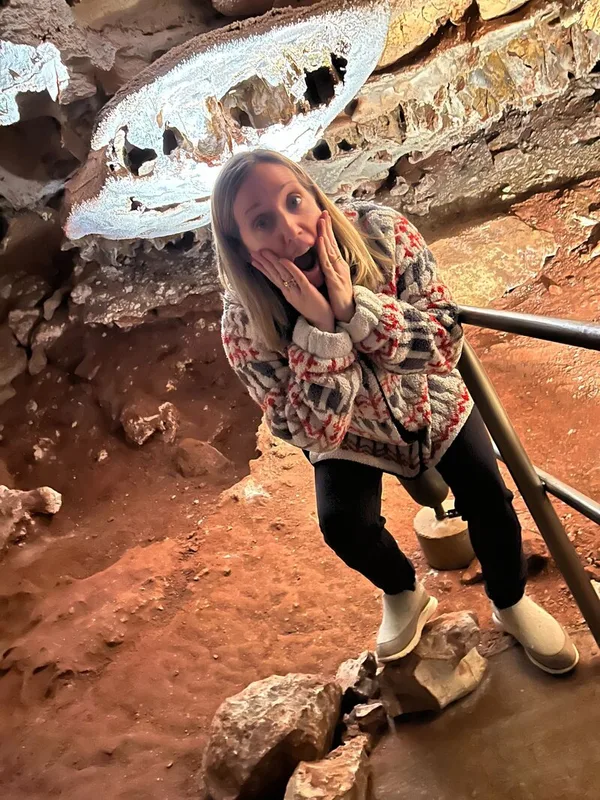
Jewel Cave, located south of the Black Hills and not far from the slowly emerging monuments of Mount Rushmore and Crazy Horse, is one of the longest caves in the world. Its walls are adorned with calcite crystals that reflect light like shattered chandeliers—magical, otherworldly, and chilly. (There’s also an exploration tour for those aged 16 and up that requires crawling through tight spaces. I can fit, so I’ll definitely return when my kids are old enough.)
Wind Cave tells a different story. Named for the breeze that flows in and out of its entrance—caused by changing air pressure above ground—it’s as if the Earth has lungs. When we left, my children and I could hardly pull the door shut; it felt as if the cave wanted to keep breathing.
The Story of Wind Cave
The Lakota people call this place Washun Niye, which translates to "the breathing hole of the Earth," and regard it as a sacred site where bison and their people first appeared in the world. In 1881, white settlers "discovered" this entrance. By 1903, it had become a national park. The story of Alvin McDonald, a teenager who explored the nooks and crannies of Wind Cave in the late 1880s and kept a journal of everything he found, is particularly noteworthy. He mapped it, named the rooms, and guided visitors inside, charging fees and sometimes leaving them overnight in the dark while he ventured elsewhere.
Alvin passed away from typhoid fever at just around 20 years old, having explored more than anyone before him. The conservation staff recount his story with heartfelt sincerity: here was a child with a candle and a notebook, driven by an intense curiosity about what lay around the next bend, seemingly unconcerned about the comfort of others. I found something relatable in that.
✈️ Tìm chuyến bay giá tốt
Đặt vé ngay với giá ưu đãi từ các hãng hàng không
The Beauty of Imperfection
Our guide mentioned that visitors often wonder whether Wind Cave and Jewel Cave connect underground. Both caves are not fully explored—there are still many uncharted passages—so no one knows for sure. Perhaps not, she said; Jewel lacks the wind phenomena, suggesting they are two separate systems. But who knows? Throughout the trip, I kept pondering that uncertainty.
South Dakota turned out to be a place filled with beautifully imperfect mysteries: caves that may or may not be connected, a monument still being carved after seven decades, a history still being shaped. There’s so much more to come.
Bison and Crazy Horse
Above Wind Cave, bison grazed in the cold. Bison in America were nearly hunted to extinction by the late 19th century, dwindling from around 30 million to just about 1,000. Wind Cave National Park became a key area for their revival in 1913, and this recovery has been successful. Now, the park hosts a free-roaming herd of about 400 to 600 bison. They are massive, indifferent, and barely flinched as my car approached.
I sat and waited while a young bull stood in the middle of the road, looking at me with a calmness I can only describe as philosophical tranquility. The Lakota say that the bison appeared here. They nearly vanished. But now they’re back. The cave continues to breathe.
The Story of Crazy Horse
Jerry Turley told me that the image of Crazy Horse impressed him even more than Rushmore. He was right. Rushmore is extraordinary—the feat of carving four giant faces is something no image can prepare you for. But Crazy Horse, still being carved after seven decades since sculptor Korczak Ziolkowski began in 1948, carries a different weight. Ziolkowski passed away in 1982 without seeing it completed. His family continues the work. He built something he knew would outlast him, and that makes it all the more poignant than the four completed faces.
Arthur Hillson also advised me: skip the tourist shops at Rushmore and buy a blanket directly from a Native artisan. That’s a good tip I’ll remember for my upcoming travels.
I drove back through Deadwood as the day faded, a town steeped in its own legends, with saloons and history museums piled on top of one another. Catherine Laton reminded me to bring water in Badlands. I did. She was right about that too. Atlas Obscura lists 64 sites in South Dakota—many places I haven’t yet had the chance to visit. There’s still so much to explore.
- Louise
PS - This is part of my journey to explore all 50 states before our nation’s 250th birthday on July 4th. I hope you’ll share your thoughts on traveling across America with me via email at ceo@atlasobscura.com
```
Phê Vé
Phê Vé is a leading online flight booking platform in Vietnam, providing accurate and up-to-date travel information. We are committed to delivering wonderful travel experiences with the best prices on the market.