
Phê Vé
April 11, 2026 • 6 min read
In the land of the Blackfoot, borders are not just lines on a map but connections of culture and history. Join us on a journey back to our roots through untold stories.
The Land of the Blackfoot
From a high hill overlooking the vast grasslands of northern Montana, the ancestral lands of the Blackfoot unfolded before me. To the west, the rolling peaks of Glacier National Park rose majestically, while to the north, the steep limestone cliffs of the Rocky Mountains towered. According to our guide, Lailani Upham, a member of the Blackfoot community, this area is known as Miistákis — "the backbone of the world."
Today, "the backbone of the world" has become a border. Lailani leads groups on cultural walking tours through the public lands of Montana with her company, Iron Shield Creative, where she weaves Blackfoot legends into outdoor explorations.
A Love for Bison
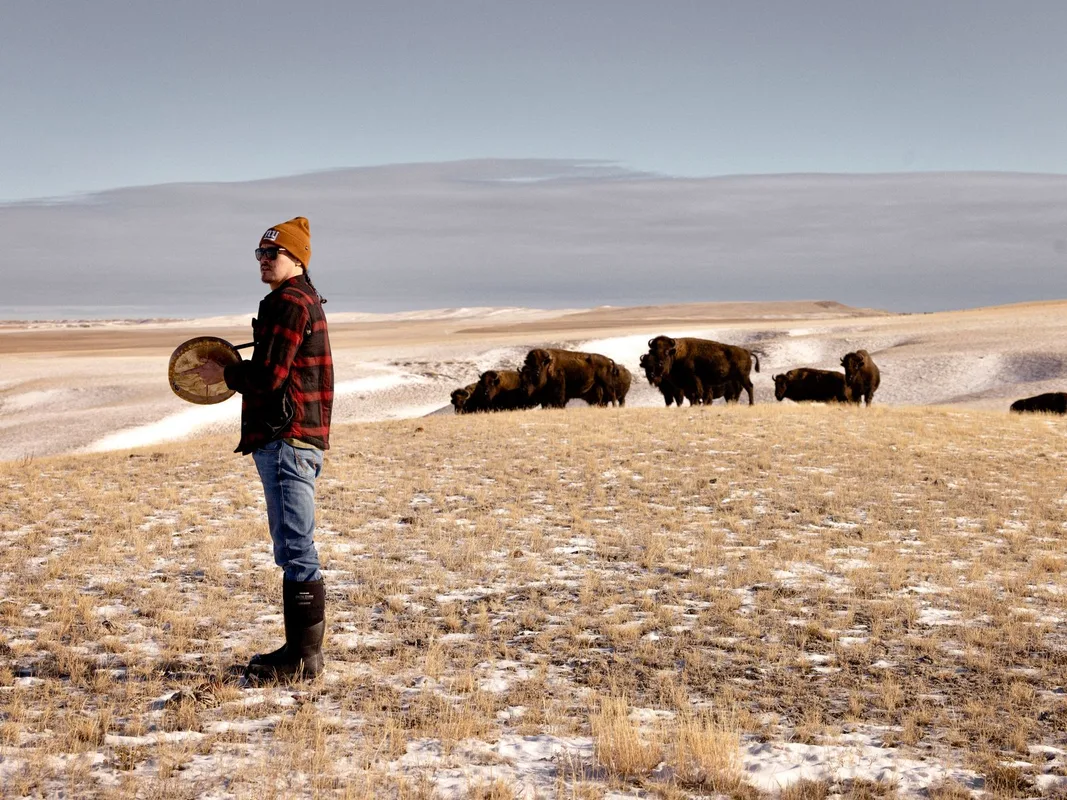
As her colorful skirt danced in the wind, Lailani shared that whenever she brings visitors to this hill, she often asks them to imagine the millions of bison that once roamed this land until settlers hunted them to near extinction by the late 19th century. We didn’t have to imagine for long, as moments later, we spotted a massive herd of bison grazing in the distance — something that would have been unimaginable just a decade ago.
Before European encroachment, the Blackfoot had a deep relationship with the bison, viewed as a spiritual relative and a vital source of food and shelter. In fact, they referred to their lands as Nititawahsi ("land where bison dwell") and called themselves Niitawahsin-nanni ("the people of the land where bison live").
Restoring the Bison Herd
Over the past decade, the Blackfoot community has worked tirelessly to restore the bison herd to their ancestral lands near Browning, Montana. This effort is the result of a significant collaboration between the Blackfoot community in the U.S. and the three nations of the Blackfoot Confederacy in Canada. When I asked Lailani how it feels to see the herd return, she said the land now "truly feels like our home."
Today, the Blackfoot Confederacy comprises about 40,000 members across four nations in the U.S. and Canada: Kainai (Blood) and Siksika in Alberta, along with two Piikani nations — Piikani in Alberta and Aamskapi (Southern) Pikuni in Montana (recognized federally in the U.S. as Blackfeet Nation) — separated by the international border.
A Special Connection Between Nations
While each nation has its own governance, the Blackfoot communities in the U.S. and Canada "have had ties since ancient times," according to Kimmy Shade, CEO of the Blackfoot Confederacy Tribal Council. She noted that it was only after establishing the Tribal Council in 2018 that they began to have dedicated individuals focusing on building Blackfoot-led tourism networks across both sides of the border.
The result is the Destination Blackfoot project, a developing tourism corridor throughout the Confederacy that makes the U.S.-Canada border feel almost non-existent. "Given the controversial issues between Canada and the U.S., this is a great opportunity to tell a positive story of collaboration," Shade said.
✈️ Tìm chuyến bay giá tốt
Đặt vé ngay với giá ưu đãi từ các hãng hàng không
Layers of Cultural Depth
Thanks to the protective nature of the border, families have maintained connections on both sides. The international border is also known as the "medicine line," a term dating back to the 19th century when Plains people, including the Blackfoot, realized that the U.S. military would not follow them into Canada, creating a sense of supernatural protection.
While the original purpose may have been division, this border surprisingly provided safety for the community. Now, to help visitors experience indigenous culture in both countries, Destination Blackfoot has created eight self-guided routes (available on a custom Google map) featuring diverse experiences on Blackfoot lands, highlighting over 100 service providers from the four nations, from Aamskapi Pikuni operators like Lailani in Montana to Piikani-managed accommodations like the Pale Horse Tipi Camp in Alberta.
A Journey Through Blackfoot
I began my five-day journey from Calgary to Glacier National Park. Starting in downtown Calgary at the workshop of Melrene Saloy, founder of the Native Diva Creations brand, which brings Blackfoot designs to the fashion runways of Paris, Milan, and New York. Under her meticulous guidance, I crafted a traditional Blackfoot geometric design onto a leather bag.
Then, driving north out of the city, I felt the vastness of Blackfoot land as the landscape shifted from rolling hills to wide-open prairies and expansive skies. In Siksika Nation, I stopped at the Blackfoot Crossing Historical Park, where a glass and steel tipi-shaped museum showcased interpretive exhibits about Blackfoot history.
Treaties and History
Here, elder guide Grant Many Heads showed me a map of the Blackfoot's traditional territory, stretching from the slopes of the Rockies, through the Great Sand Hills of Saskatchewan, and from the North Saskatchewan River in Alberta to the Yellowstone River in Montana. "Now there are only these small reserves left," he pointed to four red dots representing Blackfoot land, nearly swallowed by the vast landscape.
These "small reserves" are the result of Treaty 7, signed between the three Blackfoot nations and Canada in 1877, during a turbulent time when dependence on whisky was rampant and the economy and culture were devastated by the decline of bison populations. The Blackfoot agreed to peace, not land surrender — "there's no word for that in our language," Many Heads explained — but the treaty led to significant territorial loss and confinement to limited reserve lands.
A Promise for the Future
In 1977, a century later, Prince Charles visited and reenacted the treaty signing — the ceremonial pipe he smoked is displayed in the museum. Charles wanted to learn about the Blackfoot, Many Heads recalled, "but we couldn’t really tell him because we had nowhere to point him to."
This lack prompted the establishment of Blackfoot Crossing, which shares the Blackfoot story through artifacts, workshops, and performances. As the 150th anniversary of the treaty approaches in 2027, the museum is expanding — though, as Many Heads noted, "we do not celebrate it, we commemorate it" — with new exhibits and a stage for concerts, possibly even a festival.
"What if Charles comes back in 2027?" I asked. "Oh, there will be a completely different energy," he replied with a smile. "We will be able to explain ourselves as a people much more effectively." On that day, he added, people won’t be learning about the Blackfoot from the Blackfoot themselves.
Next, I drove south toward the U.S.-Canada border, where a guard in uniform sat in a cabin beside a large gate. As I handed him my documents, I looked up at Ninaistako (Chief Mountain), the square-shaped mountain that loomed majestically, seemingly softening the air around it.
Phê Vé
Phê Vé is a leading online flight booking platform in Vietnam, providing accurate and up-to-date travel information. We are committed to delivering wonderful travel experiences with the best prices on the market.